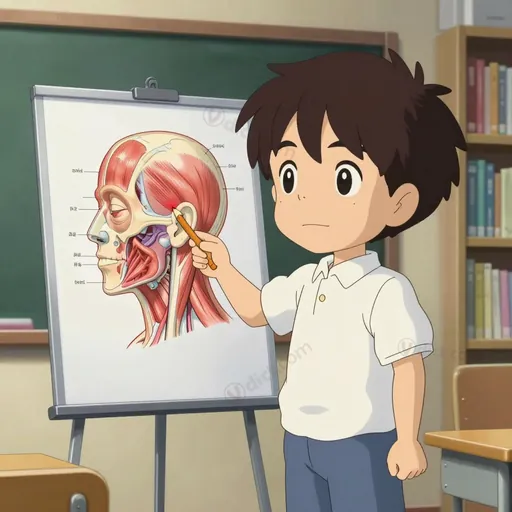
temporal muscle
Definition
Noun: * Temporal Muscle: A muscle extending from the temporal fossa (a shallow depression on the side of the skull) to the coronoid process of the mandible (a bony projection on the lower jaw). Its primary action is to elevate the mandible (raise the lower jaw) and close the jaws.
Usage
- The temporal muscle is one of the major muscles involved in mastication (chewing).
- A well-developed temporal muscle is often visible on the sides of the head.
- Strain or injury to the temporal muscle can cause pain while chewing.
Advanced Usage
- Anatomical Context: In detailed anatomical descriptions, the temporal muscle is often discussed alongside the masseter, medial pterygoid, and lateral pterygoid muscles as part of the masticatory muscle group.
- Clinical Context: The temporal muscle may be referenced in discussions of temporomandibular joint (TMJ) disorders, bruxism (teeth grinding), or surgical procedures involving the skull and jaw.
Variants and Related Words
- Temporalis Muscle: This is the full anatomical name and a direct synonym for the temporal muscle.
- Temporalis (noun): A commonly used shorter form in medical and anatomical terminology. (e.g., "The temporalis originates on the temporal bone.")
Synonyms
- Temporalis Muscle: The precise anatomical synonym.
- Temporalis: The abbreviated form.
Related Phrases
- Temporal fossa: The area of the skull where the temporal muscle originates.
- Coronoid process: The part of the mandible (lower jaw) where the temporal muscle inserts.
- Masticatory muscle: A category of muscles for chewing that includes the temporal muscle.
Noun
-
muscle extending from the temporal fossa to the coronoid process of the mandible; acts to raise the mandible and close the jaws
Khám phá thêm
Các từ liên quan
Từ đồng nghĩa